Water Heater Repair in Temecula, CA
Temecula Water Heaters diagnoses and repairs gas and electric water heaters — thermocouples, gas control valves, heating elements, thermostats and T&P valves — across Temecula, CA. A handful of underlying failures account for nearly every service call we get in Temecula. Pinning down which one you have is what separates a five-minute fix from a unit that needs to be replaced outright.
Get Your Free Water Heater Quote
Tell us about your water heater needs and we will send you a quote with no obligation.
Common Water Heater Problems and What They Mean
No hot water at all
On a gas unit, this usually means the pilot or igniter is out, the thermocouple has failed, or the gas control valve is dead. On an electric tank, look first at the red high-limit reset button or a burned-out upper element before assuming the whole unit is dead. A tripped breaker is worth checking first.
Not enough hot water
If hot water used to last through two showers and now barely covers one, look at sediment eating into usable capacity, a dead lower element, a cracked dip tube, or a thermostat dial set too conservatively. When capacity has never kept up, even from day one, chances are the builder installed a tank too small for the household.
Popping, rumbling or crackling noises
That noise is trapped water flashing to steam beneath a crust of hardened mineral scale — expected given the 15-20 gpg hard water Rancho California Water District and Eastern Municipal Water District deliver. Flushing the tank is worth trying first, though a unit that's been rumbling for several years may already have burner-floor damage a flush can't undo.
Leaking
Don't assume the tank is finished until you've traced the water. Drips at the drain valve, relief valve, or the hot/cold nipples are usually a straightforward fix, while moisture seeping from the tank shell itself means the unit is done. See water heater leak repair.
Pilot light won't stay lit
Usual culprits are a weak thermocouple or flame sensor, a clogged pilot orifice, or a combustion-air screen choked with dust — common in garage installs across warm Temecula summers. If relighting it never sticks, the unit needs an actual diagnosis rather than a repeat visit with a lighter.
Heating element failure
Most electric tanks run on two heating elements. A dead lower element still leaves some warm water; a dead upper element leaves almost nothing. Swapping an element is one of the more affordable repairs on the list.
Thermostat problems
Water temperature that's too hot, too cool, or all over the map generally traces back to a thermostat that has lost calibration or isn't seated firmly against the tank wall.
Pressure relief valve discharge
A relief valve letting water out is functioning correctly — the real question is what's forcing it open. Municipal pressure spikes, thermal expansion in a closed plumbing system, or an overheating tank can all set it off. It should never be capped or plugged.
Sediment and corrosion
Sediment buildup cuts into both recovery speed and usable capacity. Corroded fittings can usually be swapped out, but once corrosion reaches the tank shell itself, the unit is living on borrowed time and replacement is the straightforward recommendation.
How a Repair Visit Usually Goes
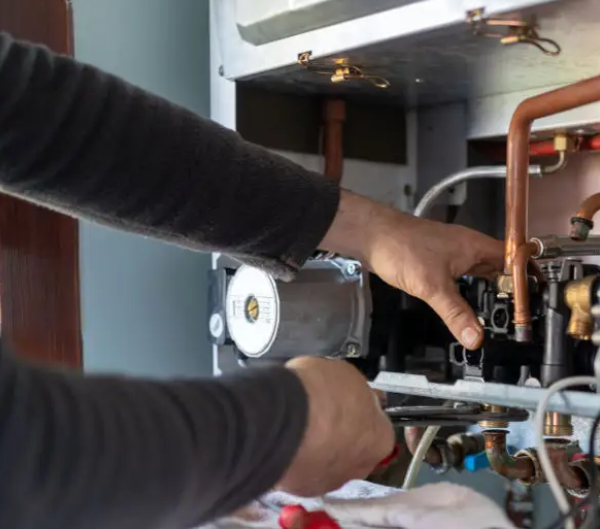
A typical visit starts with confirming what you're experiencing, verifying fuel or power is reaching the unit, checking tank temperatures, examining the burner and venting on gas models (or elements and thermostats on electric ones), and checking every connection and the relief valve for seepage.
You should walk away knowing exactly what broke, what fixing it takes, and whether it's even worth doing given the unit's age. Sinking money into a new gas control valve on a tank pushing thirteen years rarely pencils out against its remaining service life.
Repair or Replace? A Practical Way to Decide
- Under 8 years old, single component failure — repair is usually the right call.
- 8 to 12 years, second or third repair — get replacement pricing before authorizing the repair.
- Any age, leaking from the tank body — replacement, without exception.
- Repair quote approaching half of a new install — replacement typically wins on value.
- Household outgrew the unit — a repair won't fix an undersized tank.
Maintenance can stretch the life of a borderline unit, but it won't undo corrosion that's already underway.
What Breaks First on Temecula Water Heaters
Local supply water runs hard, typically in the 15 to 25 grain range across Rancho California Water District and Eastern Municipal Water District service areas. That mineral load is the single biggest reason Temecula tanks fail early: scale blankets the burner floor or bakes onto electric elements, so the unit rumbles, takes longer to recover and eventually splits at a weld.
The second pattern is heat. A garage in Temecula or Murrieta can sit above 100°F through a late-summer week, which is hard on gas control valves and thermocouples. If your heater is pilot-out every few weeks in August, the control, not the pilot, is usually the part that needs attention.
- Rumbling and popping from hard-water scale on the tank floor
- Failed gas control valves and thermocouples in hot garages
- Burned-out upper or lower elements on electric units in closets and attics
- Corroded nipples and flex connectors on 12-to-15-year-old builder-installed tanks
Related Water Heater Services
Water Heater Leak Repair
Finding the source and deciding on next steps.
Water Heater Maintenance
Annual service that prevents repeat repairs.
Emergency Service
Active leaks and total hot water loss.
Temecula-Area Communities We Cover
We connect repair requests with pros who regularly service homes throughout Temecula, Wine Country, and greater Riverside County.
- Murrieta, CA
- Menifee, CA
- Wildomar, CA
- Lake Elsinore, CA
- French Valley, CA
- Winchester, CA
- Fallbrook, CA
- Canyon Lake, CA
- Sun City, CA
- Bonsall, CA
- Hemet, CA
Diagnostics: Components, Tools and Failure Modes
What gets tested on a gas unit
Millivolt output from the thermocouple or thermopile, flame rectification on electronic ignition models, manifold pressure at the gas control valve, draft at the hood, and the condition of the FVIR flame arrestor screen. Weak millivolt output and a dust-loaded arrestor account for most nuisance pilot outages in warm garages.
What gets tested on an electric unit
Element resistance in ohms, continuity across the ECO high-limit, thermostat calibration and tank-wall contact, and voltage at the double-pole breaker. A shorted element usually shows up as a repeat breaker trip rather than lukewarm water.
Failure modes worth knowing
Dip tube fracture, sacrificial anode depletion followed by shell corrosion, scale-insulated burner floor, and thermal expansion pushing the T&P relief valve open. Diagnosing which one you have decides repair versus replacement.
Frequently Asked Questions
Why does my water heater keep running out of hot water?
Look at sediment eating into tank volume, a burned-out lower element on an electric model, a cracked dip tube, or simply a tank that was never sized for how much hot water your household actually uses.
Does a leaking water heater always mean replacement?
No. Drips at the drain valve, relief valve, or the supply-line connections are frequently fixable without swapping the tank. But moisture originating from the tank shell itself means the steel has rusted through, and at that point replacement is the only real option.
What causes a rumbling noise in a water heater?
Mineral deposits have baked onto the tank floor and steam is escaping through that crust — a common story with the hard water found across the Temecula Valley. A professional flush usually quiets the noise and brings back lost efficiency, though years of neglected buildup can shave real years off the tank's lifespan.
How often do heating elements fail?
Elements are consumables. Given the mineral content coming out of local taps, elements can scale up and fail within just a few years — fortunately, they're one of the cheaper parts to replace.
Is a pilot light that keeps going out a safety concern?
Treat it as something to have looked at, not lived with — the cause is usually a worn thermocouple, a dirty pilot assembly, or restricted combustion air. If you ever smell gas, that's not a wait-and-see situation — leave the area and call your gas utility right away.
Can regular maintenance prevent repairs?
It prevents some of them. A yearly flush paired with an anode-rod check and a relief-valve test heads off most of the failures that generate repeat service calls.
Request Help With Your Water Heater
Tell us a little about your home and the water heater you currently have. We will send you a quote with no obligation.
Not sure which service fits your situation? Pick Not Sure on the form and describe the symptoms — plenty of homeowners are troubleshooting a water heater for the very first time.
Get Your Free Water Heater Quote
Tell us about your water heater needs and we will send you a quote with no obligation.