
Tankless Water Heaters in Temecula, CA
Temecula Water Heaters sizes, installs and descales condensing and non-condensing tankless water heaters throughout Temecula, CA. By heating water on demand instead of storing a fixed volume, tankless units skip the standby losses of a 40 or 50-gallon tank and keep delivering hot water as long as the tap stays open. For Riverside County homes on Rancho California Water District or Eastern Municipal Water District supply, sizing and scale control take some local know-how before installation.
Get Your Free Water Heater Quote
Tell us about your water heater needs and we will send you a quote with no obligation.
How a Tankless Water Heater Works
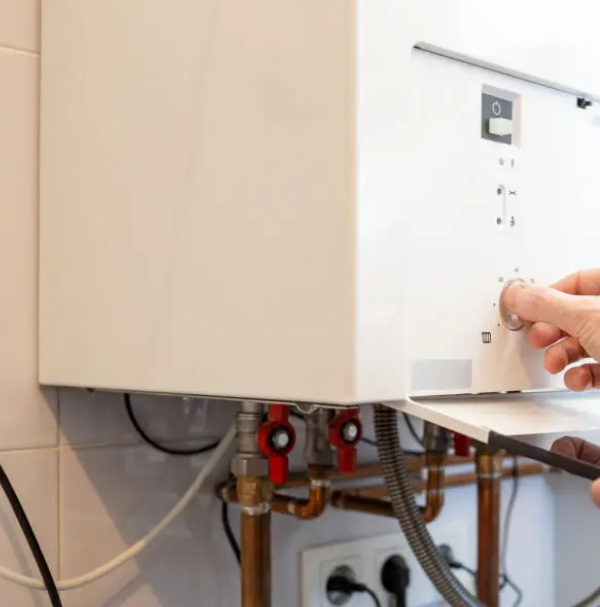
Open a hot tap and a flow sensor fires a high-output burner or element. Incoming water travels across a heat exchanger and comes out at the target temperature within moments. The unit powers back down the instant the fixture is closed, since nothing is being held in reserve — no idle tank sitting around with a full load of water that could eventually fail.
The catch is that capacity is expressed as flow rate at a stated temperature rise rather than as stored gallons, and that flow figure is what decides whether the household can run two showers together.
Sizing a Tankless Unit for Northern California Water
Correct sizing comes down almost entirely to the delta-T between incoming water and your setpoint. Well and imported water reaching a Temecula-area house runs noticeably cooler in the winter months than in summer, so a heater specified for a warm-climate temperature rise will underperform once the weather turns.
Proper sizing starts by totaling the fixtures likely to run at once — around 1.5 to 2.5 GPM per shower, under 2 GPM for a kitchen tap — then confirming the unit's rated output at the coldest expected inlet temperature rather than trusting the marketing spec. That's why so many whole-house jobs around Temecula end up specifying higher-BTU condensing gas models.
Nearly every complaint about tankless performance traces back to a unit sized too small for winter demand, so it pays to nail down flow and temperature rise before a quote is finalized.
Gas and Electric Tankless Options
Gas tankless
This is what most whole-house installs use. Plan on a dedicated vent run (stainless for non-condensing units, PVC for condensing ones), a condensate line if the model condenses, and frequently a larger gas line, since these burners pull considerably more BTUs at peak than a storage tank ever would. Related: gas water heaters.
Electric tankless
No venting is needed at all, but running an entire house on electric tankless demands heavy amperage and often forces a panel upgrade. Where they earn their keep is as a dedicated unit feeding a detached bathroom, a garage sink, or a room addition. Related: electric water heaters.
Installation Requirements and Maintenance
What installation involves
A proper install covers wall mounting, a vent path with the required clearance from windows and air intakes, service isolation valves, condensate management where applicable, and a check that the gas line or electrical circuit can actually support the unit. Our water heater installation page covers the complete process.
Descaling and upkeep
Temecula's hard water, typically in the 15 to 20 grain-per-gallon range, scales heat exchangers steadily over time. That's why most manufacturers specify periodic descaling — usually once a year in areas like ours — flushed through the isolation valves a competent installer will have already installed. Rinse the inlet filter screen during the same visit. Stay on that schedule and output and efficiency hold up; see water heater maintenance.
Is Tankless Right for Your Home?
Going tankless is worth considering when the household consistently outpaces its current tank, when reclaiming floor space matters, when you expect to stay long enough to recoup the higher install cost, or when venting work is already on the table for other reasons.
A standard storage tank still wins on value when the existing unit keeps up fine, when minimizing upfront spend is the priority, or when the gas and vent upgrades needed for conversion would be costly. Either direction is addressed under water heater replacement.
Sizing Tankless for Temecula's Climate and Water
Temecula's mild inlet water temperature is a real advantage for tankless. Groundwater and imported supply arriving through Rancho California Water District rarely drops to the near-freezing levels that force oversizing in colder states, so a well-chosen unit here often delivers full flow to two showers at once instead of one.
The catch is hardness. Without a softener or a scale-inhibiting filter, a tankless heat exchanger in Temecula needs descaling roughly once a year to keep its warranty and its efficiency. Gas conversions also usually mean a larger gas line and new stainless venting, plus a permit through the City of Temecula or Riverside County.
- Annual vinegar descaling with isolation valves, faster here than in soft-water regions
- 3/4-inch gas line upsizing on most Wine Country and Redhawk-era homes
- Ultra-low-NOx condensing models compliant with South Coast AQMD
- Condensate routing for attic and upstairs-closet installations
Related Water Heater Services
Water Heater Installation
What a proper mount, vent and gas hookup involves.
Water Heater Maintenance
Keeping the heat exchanger scale-free year to year.
Tank Water Heaters
Storage tanks compared side by side, and where they beat tankless.
Temecula-Area Communities We Cover
Our crews handle tankless installs and service calls throughout the wider Temecula service area.
- Murrieta, CA
- Menifee, CA
- Wildomar, CA
- Lake Elsinore, CA
- French Valley, CA
- Winchester, CA
- Fallbrook, CA
- Canyon Lake, CA
- Sun City, CA
- Bonsall, CA
- Hemet, CA
Sizing, Gas Load and Heat Exchanger Care
Flow rate and temperature rise math
Sizing is driven by delta-T. Temecula groundwater and imported supply typically enters between 60°F and 72°F, so a 120°F setpoint needs roughly a 50°F to 60°F rise — comfortably inside a 180,000 to 199,000 BTU/h condensing unit at 6 to 7 GPM.
Gas line and venting upgrades
A 199,000 BTU/h burner usually requires 3/4-inch or 1-inch supply, a load calculation back to the meter, and in some cases a meter upsize. Condensing models vent in PVC with a condensate drain and often a neutralizer; non-condensing models need stainless Category III venting.
Scale management on the heat exchanger
Hard water is the main enemy of a copper or stainless heat exchanger. Isolation valves with service ports allow an annual descale with a food-grade descaling solution, and an inline scale filter or softener extends exchanger life considerably.
Frequently Asked Questions
Do tankless water heaters really never run out of hot water?
Hot water keeps coming as long as total demand stays under the unit's rated flow. Push past that ceiling — three showers running plus a load of laundry, for instance — and the output temperature starts to slip. Correct sizing is what makes the no-run-out claim hold up.
How long do tankless water heaters last?
Manufacturer estimates typically put tankless service life well past that of a storage tank, but reaching those numbers depends heavily on staying current with descaling. Skip that maintenance in hard water and a unit will fall well short of its rated lifespan.
Will a tankless water heater require a larger gas line?
Frequently, yes. A high-output gas tankless unit can pull far more BTUs at peak than any storage tank, which means the existing gas line and meter need to be checked for capacity before the swap happens.
Does a tankless water heater perform well during California winters?
It will, provided sizing accounts for winter inlet temperatures. The identical unit delivers fewer usable gallons per minute in the coldest months than in summer, which is exactly why the sizing calculation should be built around the cold-season temperature rise, not the summer one.
How frequently does a tankless unit need descaling?
Once a year is the typical guidance for hard-water regions, and some manufacturers require documented descaling to keep the warranty valid. With isolation valves already in place, it's a routine service call rather than a major job.
Can a tankless unit go in the same spot as my old tank?
In most cases yes, and it opens up floor space in the process — though the available vent route, gas line capacity and condensate routing usually matter more than reusing the exact spot the old tank occupied.
Request Help With Your Water Heater
Send a few details about your home and your current water heater. We will send you a quote with no obligation.
Not sure which service you need? Choose Not Sure in the form and describe what's happening, most homeowners are diagnosing the problem for the first time.
Get Your Free Water Heater Quote
Tell us about your water heater needs and we will send you a quote with no obligation.